Ultimate Guide to Silicone Color Paste Mixing Process 2026: Step-by-Step Open Mill Compounding Tutorial for Perfect Color Uniformity
In the competitive silicone rubber industry, silicone color paste mixing process (also known as color masterbatch compounding or pigment dispersion) is the make-or-break step that determines whether your final products look professional or end up with visible color spots, streaks, or migration issues. Whether you produce medical-grade tubing, food-contact seals, automotive weatherstrips, or consumer electronics keypads, poor mixing leads to batch rejection, customer complaints, and wasted material.
This comprehensive 2026 guide walks you through every detail of the open mill mixing process for silicone color paste, based on real factory experience with HCR (high consistency rubber) silicone. You’ll get exact parameters, formulation examples, troubleshooting charts, quality standards, and process-specific advice for extrusion, compression molding, and LSR applications. By the end, you’ll be able to achieve consistent ΔE < 1.0 color matching while preserving tensile strength, elongation, and hardness.
Table of Contents
- 1. Why Proper Silicone Color Paste Mixing Matters
- 2. Raw Materials & Recommended Formulations
- 3. Complete 8-Step Open Mill Mixing Process
- 4. Key Process Parameters & Equipment Settings
- 5. Common Problems & Professional Solutions
- 6. Quality Inspection Standards & Testing Methods
- 7. Process-Specific Considerations (Extrusion, Molding, LSR)
- 8. Advanced Tips, Best Practices & 2026 Trends
- 9. FAQ – Silicone Color Paste Mixing
1. Why Proper Silicone Color Paste Mixing Matters
Color paste (color masterbatch) is a high-concentration pigment pre-dispersed in a silicone carrier. When mixed correctly, it delivers vibrant, uniform color without affecting the base silicone’s mechanical properties or vulcanization behavior. Poor dispersion, however, causes:
- Visible color specks, streaks, or marbling
- Color migration after vulcanization or during long-term use
- Reduced tensile strength and elongation at break
- Inconsistent hardness (Shore A)
- Increased scrap rates and production delays
High-quality mixing ensures ΔE values below 1.0, FDA compliance for medical/food-grade parts, and long-term color stability under heat, UV, and chemicals.
2. Raw Materials & Recommended Formulations
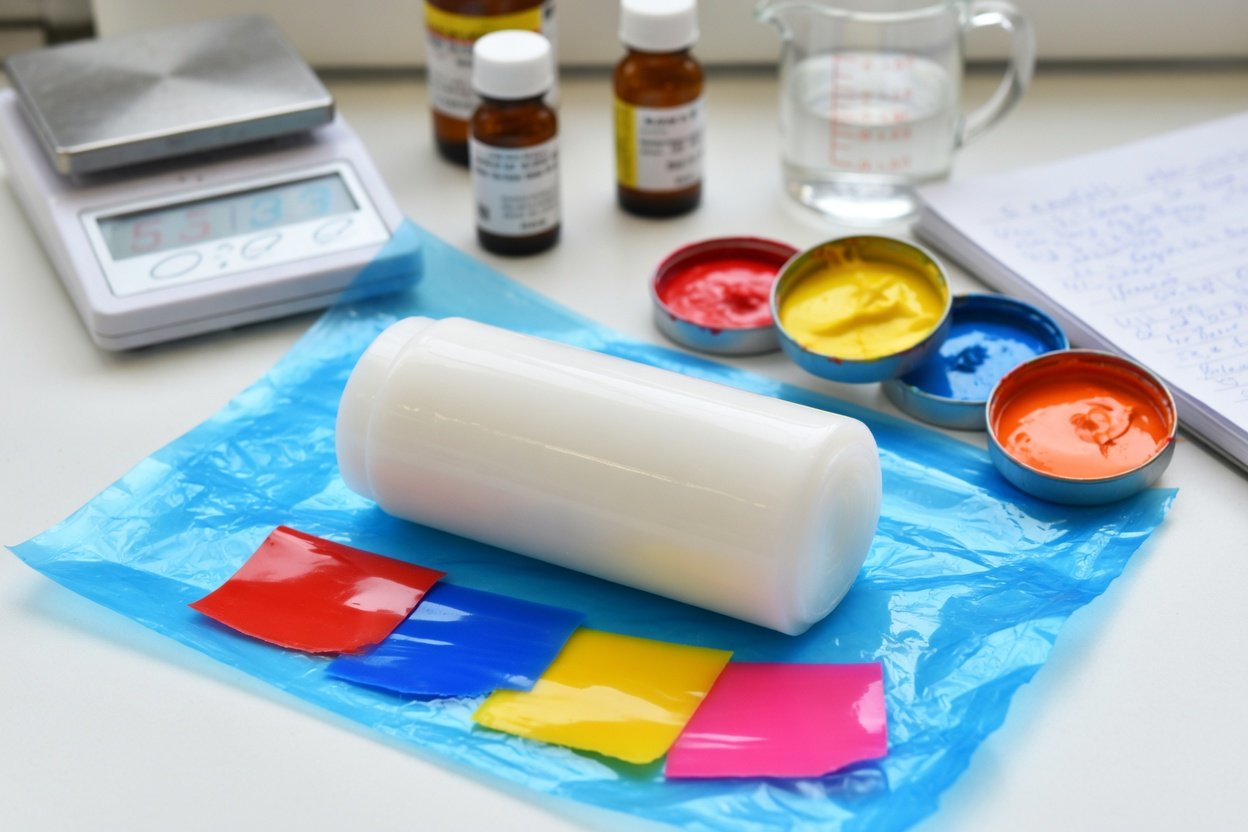
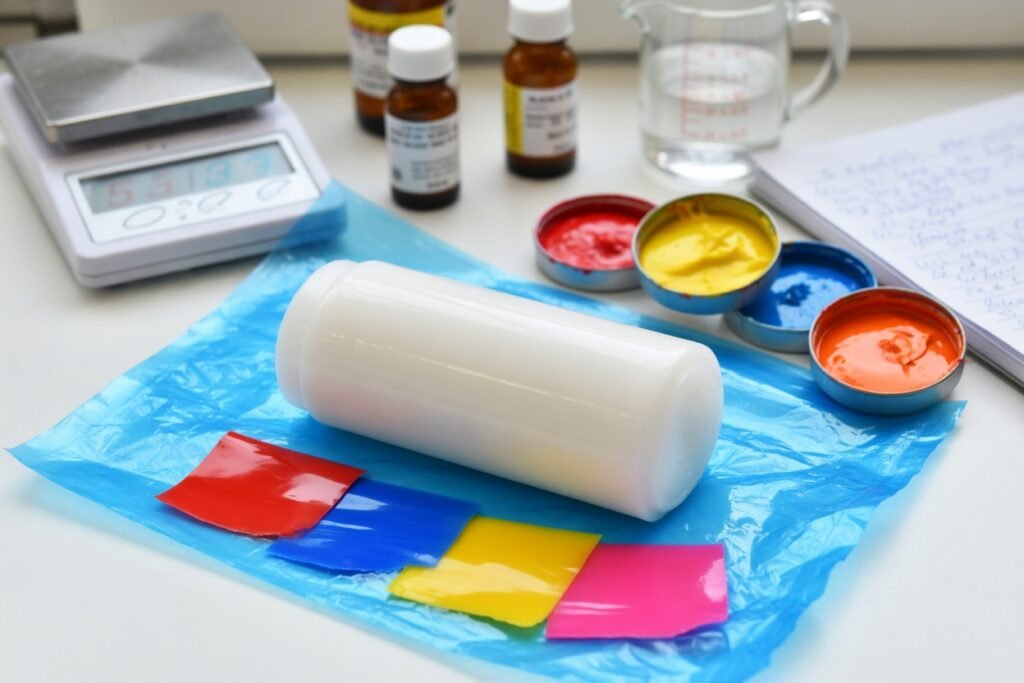
Base Silicone: Use VMQ gum or pre-reinforced white silicone compound (the white cylindrical block you provided earlier is a typical example).
Silicone Color Paste Dosage (by weight):
- Light colors (yellow, pink, light blue): 1.5–4.0%
- Dark colors (red, blue, black): 0.5–2.0%
- Food/medical grade: FDA-certified pastes only
Typical Formulation (per 100 parts base silicone):
- Base silicone: 100 parts
- Color paste: 1.0–3.0 parts
- Vulcanizing agent (peroxide or platinum): 1.5–2.5 parts
Always match the color paste system to your curing method — peroxide vs. platinum — to avoid catalyst poisoning.
3. Complete 8-Step Open Mill Mixing Process
- Equipment Preheating & Cleaning (5 min)
Roll temperature 50–70°C. Clean thoroughly with white silicone to prevent cross-contamination. - Add Base Silicone & Plasticize (2–3 min)
Wide nip (8–10 mm) → narrow to 4–6 mm. Perform 2–3 triangle passes for uniform banding. - Add Color Paste in Stages (8–12 min) – Most Critical Step
Add 1/3 of paste → 3–5 thin passes → add remaining paste → repeat triangle passes until no specks remain. - Add Vulcanizing Agent (3–5 min)
Thin pass 2–3 times for complete dispersion. - Final Sheeting (1–2 min)
Sheet thickness 5–8 mm. - Cooling & Labeling
Cool to room temperature and label with batch, color %, date.
4. Key Process Parameters & Equipment Settings
| Parameter | Recommended Value | Notes |
|---|---|---|
| Roll temperature | Front 50–65°C / Rear 55–70°C | 2–5°C difference |
| Friction ratio | 1:1.1–1:1.3 | Higher shear = better dispersion |
| Total mixing time | 15–25 minutes | Adjust by color depth |
| Paste fineness | ≤20 μm (Hegman gauge) | No visible specks |
5. Common Problems & Professional Solutions
- Color specks or streaks → Add paste in smaller increments and increase thin passes.
- Color too light → Increase dosage by 0.5% and re-mix.
- Color migration after cure → Switch to compatible silicone-specific paste.
- Sticking to rolls → Lower temperature or add small amount of release agent.
6. Quality Inspection Standards & Testing Methods
- Visual: No specks, smooth surface
- Colorimeter: ΔE < 1.0 vs standard
- Mechanical: Tensile & hardness within 5% of uncolored base
- Hegman gauge: Fineness ≤20 μm
7. Process-Specific Considerations
Extrusion (tubes, strips): Color paste must withstand 120–180°C without decomposition.
Compression/Injection Molding: Platinum systems require stricter contamination control.
LSR (liquid silicone): Use static mixer instead of open mill.
8. Advanced Tips, Best Practices & 2026 Trends
2026 trends include automated color dosing systems, AI-assisted dispersion monitoring, and low-VOC eco-friendly pastes. Always perform small-batch trials (100–500 g) before scaling up.
9. FAQ – Silicone Color Paste Mixing
Conclusion & Next Steps
Mastering the silicone color paste mixing process is one of the highest-ROI skills in silicone manufacturing. By following the exact 8-step open mill procedure, precise parameters, and troubleshooting methods in this guide, you can consistently achieve flawless color uniformity while protecting mechanical performance.
Ready to implement?
- Download our free Silicone Color Paste Formulation Checklist (comment “CHECKLIST” below)
- Book a free 15-minute consultation with our technical team for custom color matching
- Share your biggest mixing challenge in the comments — we answer every question within 24 hours
Related Articles You Might Like:
- Silicone Extrusion Process: Complete 2026 Guide
- Silicone Tensile vs Hardness Testing Explained
- Platinum vs Peroxide Curing Systems Comparison
Published: March 26, 2026 | Author: Silicone Technical Team
Original content. Feel free to share with proper attribution.